Showing posts with label Business. Show all posts

Thursday, July 1, 2010

QUICKIE: In 1999, British Petroleum Had A Vision Of What Was To Come!


This is an actual advertising campaign from over ten years ago.

Truer Words Were Never Spoken

Thanks BP. For Nothing!

Once A Proud Beacon Post the 1992 Civil Unrest, Magic Johnson Theatres In Los Angeles Closes Its Doors!

Magic Johnson last month announced that his Magic Johnson theatre on Crenshaw Boulevard in Los Angeles will be shut down. What’s more interesting, however, is the fact that Mr. Johnson no longer owns the theater, having sold it to AMC a few years back.

The closing will certainly be bad news for teen employment in the area but I’m not so sure that many residents will be so sad to see it go. In a city where state-of-the-art theaters are popping up consistently, I think it’s fair to say that many neighbors venture out of the area for their movie experiences.

Still, the theater has become a landmark in the South Los Angeles landscape and it will be interesting to see what replaces it.

More importantly, what does this failed business venture say for all the talk of rebuilding Los Angeles after the riots that broke out in 1992 after the Rodney King verdict?

Here are Magic’s words on the matter:

“I am deeply saddened to learn of AMC’s decision to close the Magic Johnson Theatre at Crenshaw Baldwin Hills Mall. AMC purchased the Magic Johnson Theatres several years ago. This was my first theatre, so a piece of me will definitely close with it. I want to thank the community for their support and loyalty over the years. The theatre has truly been the heartbeat of that community. Magic Johnson Enterprises will continue to bring high quality entertainment, products and services to those communities we serve every day.”

Sunday, March 21, 2010

What's That Smell? That's Just Beyonce Making Money

Is it getting hot in here or is it just BeyoncĂ©’s ‘Heat’? The diva’s first fragrance, launched last month exclusively at Macy’s, has been setting sparks off the shelves.

A mix of magnolia, neroli and blush peach scents, Heat is currently the number one brand at Macy’s, having already sold around $3 million in its first month out — 72,000 bottles alone in a single hour during an in-person N.Y.C. appearance. The fragrance retails for $39-$59.

Source

Saturday, January 9, 2010

South LA Barber Elvie Lewis Still Hookin' Brothers Up... At 94!

Local Black-Owned Shop Has Quite A History

Past the iron-mesh security door and the empty, 20-foot-long vinyl waiting bench, Elvie Lewis gives his ancient barber's chair a slap with a striped towel to dust off the last stray wisps of hair from the customer he has just finished.

With a weary grin, Lewis plops down in the ornate chair and tugs a lever to make it recline. With his head back and his feet up, he closes his eyes.

"It isn't like it used to be. You couldn't even sit down, it was so busy. We kept this place full when I was in my prime," he says softly.

If business is a bit slow, Lewis has earned a break. He has been cutting hair for 62 years. At the age of 94, he likes to call himself Los Angeles' oldest barber.

These days, he still has a steady hand -- and an even steadier clientele. Longtime customers trickle in Tuesdays through Thursdays; a steady stream comes Fridays and Saturdays.

His regulars travel from as far as Palmdale to the three-chair shop on South Normandie Avenue that Lewis has operated since 1952. He started cutting hair in 1947.

Longtime customers praise his $15 haircuts and his upbeat attitude.

Through the years, Lewis mastered each new style that came along. There was the buzz cut of the 1950s, the bushy Afro of the '60s, the dreadlocks and cornrows of the '70s, the 1980s' mullet, the high-top fade of the '90s and today's high-and-tight.

"My favorite style is what they ask for," he says with a grin. In his zip-up barber's smock, the short, cheerful-looking Lewis favors his own receding gray hairline cropped short.

Customers say it's his smile and encouraging outlook on life -- just as much as the haircut he gives -- that keeps them coming back.

"He started doing this the same year that Jackie Robinson broke into the majors," says Derrick Blakey, 50, who has frequented the shop for 22 years.

For much of that time, Lewis has allowed Blakey to sell T-shirts embossed with uplifting sayings such as "Wealth Is Good Health" and "Think Positive" in the shop. "Mr. Lewis is more than a hairstylist. He's an artist," Blakey says. "And he's an encourager. He's supported everything I've done."

Luvert Pineset, a 73-year-old retired high-rise maintenance worker who travels from Palmdale for his trims, appreciates Lewis' old-school, gentlemanly manner. "He's a nice man," Pineset explains.

"He's still got a steady hand," adds Robert Hunter, 76, a former steelworker from South Los Angeles who has been going to Lewis for more than a decade.

Lewis puts in a 7 a.m.-to-5 p.m workday Tuesdays through Saturdays. He's on his feet whenever he's cutting hair, despite the aches and pains that come from living nine decades.

He walks with a cane now, and four years ago he turned in his driver's license, swapping it for a simple ID card from the state.

Why didn't he retire 30 years ago?

"Everybody I know who retires goes out and gets another job. I already have a job," he says. "I'm not a 'honey do' man, you know, 'Honey do this, honey do that.' If I'm going to work at home, I may as well be working here."

Lewis' wife of 56 years, Mary, drives him to and from the shop from their home on West 66th Street, about a mile away.

"About the only places I go are to church, this barbershop and the VA hospital," he says. "For 45 years, I went on vacation all over the United States and to places like the Bahamas. Now my favorite place is here."

The story continues...

Sunday, August 16, 2009

AT&T Doesn't Want You To Use Skype or Google Voice, But It's Their Horrible Service That's Driving Customers Away!

HEY AT&T, CAN YOU HEAR ME NOW???

By Kevin Ross, CEO of 3BAAS Media Group

So I pulled up to this AT&T store at 6:57pm on Sunday August 2, 2009. The front door said clear as day that this location closes at 7:00pm. Now admittedly, no one was in the store except three employees, including two ladies behind cash registers. When I walked up to the door it was locked, so I knocked on the glass and a late 20-something man gestured that they were closed.

I then asked him to walk over to the where I was. He complied.

After indicating that I was there to pay a bill, the man told me they closed at 7:00pm I said “It’s not 7:00, it’s only 6:59.” His retort was the registers were already closed out. My response was, “Why are registers closed when the store is still officially open?” The man shrugged his shoulders, and walk away. I don't have these issues with Skype, and AT&T knows it.

Initially deciding to just drop the whole thing and move on, I began walking towards a nearby take-out restaurant to get some dinner. Suddenly, I just happened to look at my ATT Blackberry, which was showing 6:58. I paused for a moment, turned around and headed back to the store. I asked the gentleman to come over again.

When he did, I showed him my AT&T phone with the time now reading 6:59. “Your company phone is even showing that you guys should not be closed yet,” I said. He then pulled out his black iPhone (the one some AT&T users have been complaining about) and showed it to me. At that point, it read 7:00pm.

“My phone says 7:00 p.m.,” the man replied. Well, it’s clear that even with his phone now reading 7:00. I should have initially been allowed to transact business. When I asked for his name he indicated he was Jarrett and he was in charge. I asked for his last name and he refused to give it to me.

When I asked for the manager’s name, he indicated his name was Adam. I advised him that I would be contacting his manager. Jarrett rudely replied, “Well, you do that – contact him.”

That's when my Blackberry camera came in handy. After snapping the picture above, I did contact Adam Garcia, the store manager. While apologizing for the situation, he went on to defend the stores actions based on several robberies that AT&T stores had been experiencing whereby criminals are waiting right up until these stores close before stealing from them at gunpoint.

As a result, AT&T, unbeknownst to the general public, has began instructing stores to close 30 minutes early then the time stated, lock the doors, and not allow additional customers to enter.

While I understand the safety precautions be implemented, it stills doesn’t excuse poor customer service being shown to customers trying to spend money with AT&T.

Mr. Garcia asked me to send him this piece before posting which I did. He said he would make sure he got back to me to discuss further. To date, Adam remains missing in action. No phone call, no email. Nothing. Nada. Zilch! Am I the only one who's experiencing this?

And yes, this is the same AT&T who’s chum (term used to measure the number of customers who leave or switch to another service) is increasing due to consumers experiencing constant dropped calls in areas where various phones show a full signal.

This is the same AT&T who is covertly trying to prevent Apple from accepting the Google Voice application because they don’t want consumers to have options. Instead, AT&T wants to subject customers to unprofessional employees. Employees that may soon need to find work in other industries, as VOIP becomes more widespread and the society finds less need for traditional phone service.

Don’t take my word on this - ask one of those 8,000 employees Verizon is laying off due to reduced demand for their product. And that’s taking place despite there aggressive marketing campaign for FIOS.

All I can say is AT&T, you need to get it together. Right now, it seems that the FCC is on you too, which means my world that has you in it does not feel close at hand. Is this thing on???

Tuesday, July 22, 2008

STOP TELEMARKETERS FROM RIPPING YOU OFF BY CALLING YOUR CELL PHONE!!!


All phone numbers became public family as of July 19, 2008

REMINDER....

all cell phone numbers are being released to telemarketing and you will start to receive sale calls and BE CHARGED FOR THOSE CALLS!

To prevent this, call the following number from your cell phone: 888-382-1222.

It is the National DO NOT CALL list. It will only take a minute of your time. It blocks your number for five (5) years. You must call from the cell phone number you want to have blocked. You cannot call from a differentphone number.

Thursday, June 19, 2008

Reason #3 Why 3BAAS Media Group Was Formed

The End of Black Online Independence???

The premiere African American magazine and online site for Black women, Essence, is no longer Black-owned. Afrocentric search engine Rushmore Drive is a subsidiary of Barry Diller's IAC company. The Root.com is a collaboration with the Washington Post. BET.com belongs to Viacom. And with the company's stock in freefall, Cathy Hughes' TV One and Radio One empire is taking a drubbing.

Now comes word that the website Africana.com, provider of online news and education aimed at people of color, is also being subsumed by AOL Time Warner through AOL’s Black Voices channel.

Who's minding the store folks?

These examples of known Internet destinations being controlled by non-Black conglomerates present a vexing problem for the independence of African Americans increasingly flocking to the information super-highway. Other than such blogs as Bossip, The YBF, Rodonline, Mediatakeout, What About Our Daughters, and of course our sites, fewer and fewer "techpreneurs" are toiling in the virtual universe.

But these visionary pioneers are committed to ensuring that Blacks control their own content and combat the negative images that, surprise, are more prevalent through Yahoo as any Klan newsletter produced in the Appalachian Heartlands.

Exhibit A: If someone had performed a Google image search under "Black Men" a few weeks ago, they would have been privy to a picture of some anonymous brother's well-endowed genitalia. No, it was not the first image dispalyed. It was the second. While it has since been removed, the first image still remains. It depicts an older Black man's back, covered in welts, post an obvious plantation-style beatdown. This is what currently defines Black men.

Everywhere!

Admittedly, the Internet is still a place where individuals can control the news, visuals and perceptions upon which others form their views. Is that compromised when ownership changes hands? How radical can these minority publications be? Can they speak to corporate abuse, criticize hiring patterns or speak out against employment discrimination? What about disparate treatment as it pertains to the promotion of our political views, art, culture and everyday life experiences?

Earl G. Graves, publisher of Black Enterprise, said that before selling to Time Warner, the owners of Essence magazine should have at least allowed Black companies to make an offer to purchase the company.

But this mindset is the reason why African Americans have not succeeded when it comes to the business of media, journalism, radio, television and film. We are still falling short when it comes to the growth and opportunites availing themselves right before our eyes.

The Black community can and should learn invaluable lessons from the Jewish community, the Asian community and the Latino community. Tri Destined Studios CEO N.D. Brown was recently telling my business partner, Valencia Roner, how everyone in Hollywood is looking for content and Black people have so much material to give them if we effectively harness our resources.

Rainmaker President and CEO Gregory Campbell shared with me how African countries, as well as places in the Caribbean and the UK, are very interested in news and information coming out of the US. The challenge is that many of us simply are not paying attention to the shifting paradigm taking place.

Ironically, while mainstream newspaper circulations are down, Black publications are still doing very well. This despite not being able to garner the advertising dollars of their White counterparts. Black Congressional lawmakers are also aggressively attempting to defeat the current XM/Sirius Satellite radio merger, in large part because of the meager opportunities the deal provides their constituents.

And while we have Will Smith, Tyler Perry, and Oprah, fewer Blacks are being hired in televsion, both in front of and behind the camera.

Some would argue that websites owned and controlled by giant corporate media entities including Viacom (CBS, MTV et al.) Disney (ABC, ESPN, et al.) AOL Time Warner (CNN et al.) GE (NBC), and News Corporation (FOX, DirectTV) discourage alternative views and completely brainwash the American psyche. But can anyone blame these businesses for simply doing what their shareholders expect them to do, i.e. make money by any means necessary?

Thus, the issue over non-Black ownership of African American content, digital of otherwise, is not a difficult one. Nor is the conversation groundbreaking. What's unique about what we're experiencing right now, however, is this new "renaissance." A renaissance potentially more profound than what took place in Harlem during the 1920s and 1930's.

If we can put a man on the moon and a biracial Illinois senator with a strong, brilliant Black woman by his side in the White House over the next few months, we can do this.

Without excuses, pity-parties, or claiming victim status, we can do this.

It just needs to be handled.

Are you in?

By Kevin Ross, CEO and President of 3BAAS Media Group. Black Slate provided source information and written content for this article.

Tuesday, June 10, 2008

BEST BUY, MY FOOT!


Best Buy has some bad policies....

This could happen to you or your friends, so be forewarned.

If you purchase something from, Wal-Mart, Sam's Club, JC Penny, Sears etc. and you return the item with the receipt they will give you your money back if you paid cash, or credit your account if paid by plastic.

Well, I purchased a GPS for my car, a Tom Tom XL.S from 'Best Buy'. They have a policy that it must be returned within 14 days for a refund!

So after 4 days I returned it in the original box with all the items in the box, with paper work and cords all wrapped in the plastic. Just as I received it, including the receipt.

I explained to the lady at the return desk I did not like the way it could not find store names. The lady at the refund desk said, there is a 15 % restock fee, for items returned. I said no one told me that. I said how much would that be. She said it goes by the price of the item. It will be $45.00 dollars for you. I said, all your going to do is walk over and place it back on the shelf then charge me $45.00 of my money for restocking? See, this is why more and more people are shopping online at places like Newegg.

She said that's the store policy, which apparently others have a problem with just like me. I said if more people were aware of it they would not buy anything here! If I bought a $2000.00 computer or TV and returned it I would be charged $300.00 dollars restock fee? She said yes, 15%.

No wonder their stock price is falling!

I said OK, just give me my money minus the restock fee. She said, since the item is over $200.00 dollars, she can't give me my money back!!! Corporate has to and they will mail you a check in 7 to ten days.!! I said 'WHAT?!'

It's my money!! I paid in cash! I want to buy a different brand..Now I have to wait 7 to 10 days. She said well, our policy is on the back of your receipt. I said, do you read the front or back of your receipt? She said well, the front! I said so do I, I want to talk to the Manager!.

So the manager comes over, I explained everything to him, and he said, well, sir they should of told you about the policy when you got the item. I said, No one, has ever told me about the check refund or restock fee, whenever I bought items from computers to TVs from Best Buy. The only thing they ever discussed was the worthless extended warranty program. He said Well, I can give you corporate phone number.

I called corporate. The guy said, well, I'm not supposed to do this but I can give you a 45.00 dollar gift card and you can use it at Best Buy. I told him if I bought something and returned it, you would charge me a restock fee on the item and then send me a check for the remaining 3 dollars. You can keep your gift card, I'm never shopping in Best Buy ever again, and if I would of been smart, I would of charged the who le thing on my credit card! Then I would of canceled the transaction.

I would of gotten all my money back including your stupid fees! He didn't say a word!

I informed him that I was going to e-mail my friends and give them a heads up on this stores policy, as they don't tell you about all the little caveats. Even as they are trying to promote themselves in a positive way.

So please pass this on. It may save your friends from having a bad experience of shopping at Best Buy. It's true! read it for yourself: Best Buy's return policy

Tuesday, May 27, 2008

Ghetto Fab Cars That Won't Ever See A Penny Of Profit

The creativity speaks for itself, but how are these folks benefitting???

Eating Cheetos In My Cheetos Ride!

More under the hood

Kraft would never have thought to do this!

Just think of the $$$MILLIONS$$$ in advertising dollars that these companies are saving by NOT paying these guys money.

Friday, May 16, 2008

LA's Santa Barbara Plaza: Black Community Gets Hoodwinked, Bamboozled, And Left Holding The Bag

REASON #367 WHY MORE OF US ARE MOVING TO THE SUBURBS

The stalled Santa Barbara Plaza development in the heart of Black LA's famed Crenshaw District suggests how badly a project can be bungled when incentives are not in line with goals.

It was supposed to have been a model of urban renewal -- a mix of housing and classy stores to replace a decaying 20-acre shopping center at the foot of the affluent Baldwin Hills. Instead, the once prime location is a collection of blight, dead or dying businesses, and a vast concrete lot with weeds pushing through large cracks. Most of the housing was never built; none of the retailers ever came.

The largely middle-class, African American area is stuck with a mostly deserted commercial slum. Southern California leaders gambled on a check-bouncing, politically connected developer to shepherd the project. And after $15 million in government subsidies and more than $30 million in private investment, taxpayers -- and the community -- have lost.

Christopher Hammond, a bespeckled, light-skinned politically connected developer, was able to draw $15 million in public funding for a retail and housing development at the foot of Baldwin Hills that remains an unbuilt eyesore that's left Black Angelenos pissed.

Government Pays Hammond 400,000 More Than Appraised Value For Property

Despite a history of questionable credit-worthiness and reliability, bounced checks, and no shortage of lawsuits from unpaid contractors and bill collectors, former city Mayor James K. Hahn and former and current City Council members Mark Ridley-Thomas and Bernard C. Parks (locked in a contetious political battle for a ) continued to work with the tall, charismatic African American brotha.

The complete article can be found here.

Sunday, May 4, 2008

Florida Black-Owned Media Company Fights Back After Taking Some Tough Body Blows

Tama Broadcasting, with two Daytona Beach African-American brothers as major shareholders, filed a lawsuit in federal court last week accusing its largest creditor of serious violations of federal and state laws as a result of a company restructuring plan gone bad.

The federal lawsuit pits Tama and brothers Dr. Glenn W. Cherry and Charles W. Cherry II, owners of nine radio stations in Florida and Georgia, against D.B. Zwirn Special Opportunities Fund, a multibillion-dollar hedge fund that is shutting down after losing the confidence of its wealthy global investors.

Tama operates WTMPAM and FM in Tampa, and four FM radio stations – WJSJ, WSJF, WHJX, and WFJO in Jacksonville, and three FMs in Savannah, Ga.

According to the National Association of Black-Owned Broadcasters, African Americans own only 220 radio and TV facilities of the 29,593 broadcast facilities that exist nationwide, or less than one percent. Tama’s nine stations represent almost five percent of the total number of Black-owned radio stations in America. Tama is the sixth-largest Black-owned broadcasting group in the country. Some consider Radio One, with 54 radio stations, as the largest Blackowned media group, although it is publicly traded.

The Cherry brothers also own substantial interests in Central Florida Communicators Group Inc., which owns the Florida Courier newspaper. Charles W. Cherry II is publisher of the Florida Courier.

The court case accuses Zwirn of trying to illegally sell Tama’s assets, of violating Federal Communications Commission laws by trying to take control of Tama’s nine stations without FCC consent, of interference with Tama’s business relationships, and of various deceptive business and lending practices under state law.

A major point of contention is that Tama leased its nine stations to Zwirn as part of a company restructuring that never happened. Zwirn immediately began to gut the stations, fire employees, and change successful programming and music formats on virtually all the stations, without Tama’s consent. Zwirn’s changes allegedly caused a listener outcry in Tampa, Jacksonville and Savannah.


The lawsuit requests that the court allow Tama to recover money damages for itself and a class of all others “similarly situated as a result of (Zwirn’s) violations of those laws,” including other small businesses located in California, Florida, Ohio, Texas, and Virginia.

Tama claims Zwirn financed firms that were insolvent or in a financial condition that made it clear they did not have the ability to repay the loan, but nonetheless were charged in excess of 28 percent interest. Tama also says that Zwirn’s loans were made only on the basis of asset appraisals.

Zwirn loaned Tama $16.5 million, net of interest and fees, in 2004 to finance the company’s growth. Zwirn now claims Tama owes close to $40 million, including interest and penalties, with the debt increasing at the rate of approximately $600,000 per month. Tama vehemently denies the amount of the debt, and subsequently sued.

Hedge funds are pools of money from wealthy individuals or groups of qualified investors whose net worth must exceed $1 million, have individual income in excess of $200,000, or joint income in excess of $300,000 in the past two years. Hedge fund investors generally are required to invest a minimum of $1 million in the funds. They are considered to be a way for rich foreigners to invest in American-owed assets without serious governmental scrutiny.

Unlike mutual funds, they are not traded on exchanges like the New York Stock Exchange, and are not registered with the federal Securities and Exchange Commission.

Daniel Zwirn, 36, who named the D.B. Zwirn group of funds after himself, earned an M.B.A. from the Harvard Business School in 1998, and then worked for various Wall Street financial institutions before managing a private fund for Dell Computer head Michael Dell.

Zwirn started his own fund in 2004 and began making money for his undisclosed investors at the rate of one to two percent a month. The Zwirn fund began loaning money to Tama Broadcasting and other radio station groups and small businesses around the country around that time.

Zwirn’s various funds doubled in size from 2004 to 2006, growing to $7 billion in 2007. Zwirn’s personal income was estimated at between $40 and $50 million a year before his funds supposedly ran into serious trouble with its investors according to a New York Times article.

“The troubles at D.B. Zwirn did not come as a surprise,” the article said. “In late 2006, the firm uncovered improper money transfers between its funds and improper charges to clients. Later, Mr. Zwirn, in a letter to investors, called the episode ‘completely unacceptable to us and deeply embarrassing.’ The firm paid clients back, with interest. But investors were shaken, and the Securities and Exchange Commission initiated an investigation.

“They stole from their clients,” said one investor who did due diligence on the fund but decided against investing. “I don’t know how you give money to a fund after that.”

“…Investors say the fund did not invest enough in risk management and financial controls required to handle such a big fund, particularly one with investments that are difficult to value. D.B. Zwirn made loans to companies around the world, including some in China.

“In a letter sent to investors, Daniel B. Zwirn, the firm’s founder, said it would take two to four years ‘or longer’ to sell the assets in an orderly fashion. His firm…is closing funds worth about $4 billion,” said the article.

The Cherry brothers believe Tama and other small companies were caught in a web of big-money Wall Street greed and dishonesty. They want other companies, including fellow entrepreneurs who received Zwirn loans as well as Tama’s creditors who were harmed by Zwirn’s conduct, to join the class action lawsuit.

“Zwirn doesn’t own our stations. Zwirn’s leadership evidently believes that various federal laws, especially Federal Communications Commission regulations, and basic fair dealing don’t apply to billion-dollar hedge funds. They tried to destroy Tama Broadcasting because we would not go along with their illegal scheme to control our federally licensed radio stations which serve the public’s interests, not the financial interests of a predatory lender that exists to make money for its secret investors,” said Tama litigation attorney Charles W. Cherry II in a written statement.

“This was a ‘loan to own’ scheme from the beginning, and we anticipate other businesses will join us in this fight. We look forward to arguing our case in front of a jury of ordinary Florida citizens. We hope Congress will assess how hedge funds, as predatory lenders of last resort, affect small, disadvantaged, and minority-owned businesses.

“It’s time to regulate hedge funds that, left unchecked, will facilitate foreign financial control of assets that operate in the public interest, such as transportation, telecommunications, and energy companies. Such foreign control is to the detriment of America’s national security and economic best interests.”

BY KARSCEAL TURNER, FLORIDA COURIER

Thursday, April 3, 2008

Who Cares If He's Marrying Beyonce, How About Jay-Z's New $150 Million Dollar Record Deal

Superstar Rapper Shawn Carter Flips The Script

Is this Black hustler turned rapper mogul creating a new model for music business?

Could be. In a move that reflects the anarchy sweeping the music business, Beyonce's jumpoff, who released his latest album to lukewarm sales five months ago, is on the verge of closing a deal with a concert promoter that rivals the biggest music contracts ever awarded.

Jay-Z plans to depart his longtime record label, Def Jam, for a roughly $150 million package with the concert giant Live Nation that includes financing for his own entertainment venture, in addition to recordings and tours for the next decade. The pact, expected to be finalized this week, is the most expansive deal yet from Live Nation, which has angled to compete directly with the industry’s established music labels in a scrum over the rights to distribute recordings, sell concert tickets, market merchandise and control other aspects of artists’ careers.

As CD sales plunge, an array of players — including record labels, promoters and advertisers — are racing to secure deals that cut them in on a larger share of an artist’s overall revenue. Live Nation has already struck less comprehensive pacts with Madonna and U2.

In Jay-Z, Live Nation has lined up with a longtime star who, after toiling as a self-described hustler on the streets of Brooklyn, earned acclaim as a rapper and cachet as a mogul.

Live Nation’s core business has revolved around major rock and country tours, and with Jay-Z it is making an unexpected foray into hip-hop. The company is also placing an enormous wager on a performer who, like many others, has experienced declining record sales. (Last year’s “American Gangster” sold one million copies in the United States; “The Black Album,” from 2003, sold well over three million.)

But the arrangement would also position Live Nation to participate in a range of new deals with Jay-Z, one of music’s most entrepreneurial stars, whose past ventures have included the Rocawear clothing line, which he sold last year for $204 million, and the chain of 40/40 nightclubs.

Jay-Z, 38, whose real name is Shawn Carter, owes one more studio album to Def Jam, where he was president for three years before stepping down in December after he and the label’s corporate parent, Universal Music Group, could not agree on a more lucrative contract.

His first undertaking with Live Nation is his current 28-date tour with Mary J. Blige, his biggest live outing in more than three years. After that, Live Nation envisions integrating the marketing of all Jay-Z’s entertainment endeavors, including recordings, tours and endorsements.

“I’ve turned into the Rolling Stones of hip-hop,” Jay-Z said in a recent telephone interview.

The deal answers a question that had been circling through the rap world for months: Where would Jay-Z take his next corporate role? As part of the arrangement, Live Nation would finance the start-up of a venture that would be an umbrella for his outside projects, which are expected to include his own label, music publishing, and talent consulting and managing. Live Nation is expected to contribute $5 million a year in overhead for five years, with another $25 million available to finance Jay-Z’s acquisitions or investments, according to people in the music industry briefed on the agreement. The venture, to be called Roc Nation, will split profits with Live Nation.

The overall package for Jay-Z also includes an upfront payment of $25 million, a general advance of $25 million that includes fees for his current tour, and advance payment of $10 million an album for a minimum of three albums during the deal’s 10-year term, these people said. A series of other payments adding up to about $20 million is included in exchange for certain publishing, licensing and other rights. Jay-Z said Live Nation’s consolidated approach was in sync with the emerging potential “to reach the consumer in so many different ways right now.” He added: “Everyone’s trying to figure it out. I want to be on the front lines in that fight.”

The popularity of music downloads has revolutionized how music is consumed, and widespread piracy has contributed to an industry meltdown in which traditional album sales — composed mostly of the two-decades-old CD format — have slumped by more than a third since 2000. (The best seller in 2007, Josh Groban’s “NoĂ«l,” sold 3.7 million copies, compared with 9.9 million for the top album in 2000, according to Nielsen SoundScan.)

That has further pressured record-label executives to rewrite the economics of their business and step beyond the sale of albums in an attempt to wring revenue out of everything from ring tones to artist fan clubs.

Jay-Z said that his future as an artist could involve elevating the role of live performances, long a mixed bag even for popular rap acts.

“In a way I want to operate like an indie band,” he said. “Play the music on tour instead of relying on radio. Hopefully we’ll get some hits out of there and radio will pick it up, but we won’t make it with that in mind.”

Though sales for Jay-Z’s tour with Ms. Blige have been strong since it began on March 22, with almost all the early dates resulting in sold-out arenas, it is unclear when Live Nation could carry out other aspects of the deal. (Jay-Z said that he hoped to deliver his final album for Def Jam later this year.)

Critics of Live Nation, which lost nearly $12 million last year, predict that it would be difficult to turn a profit on the arrangement, given the continuing decline in record sales and the mixed track record of artist-run ventures. Shares in the company have suffered since October when Live Nation negotiated a reported $120 million deal with Madonna.

Michael Cohl, Live Nation’s chairman, said he was not worried. Though he declined to discuss terms of the Jay-Z arrangement, he said it did not require an increase in record sales to be profitable. “He could be doing more tours and doing great,” Mr. Cohl said. “There could be endorsements and sponsorships.” He added, “The whole is what’s important.”

He cited Jay-Z’s forays into a host of other businesses as a model for Live Nation. “What he’s done has kind of mirrored what we want to do and where we think we’re going.”

Some executives at major record labels have privately portrayed Live Nation’s artist deals as overly expensive retirement packages for stars past their prime.

Others disagree. “I’d much rather be in the business of marketing a superstar who cost me a lot of money than taking the 1-in-10, demonstrably failing crapshoot” of signing unknown talents, said Jeffrey Light, a Los Angeles entertainment attorney, referring to the traditional record company model.

But the dimensions of the competition could change if Live Nation begins vying for the same emerging artists that the labels hope to sign. Live Nation is negotiating with a Georgia rock act, the Zac Brown Band, after apparently wooing it away from an offer by Atlantic Records, according to music executives briefed on the talks.

Jay-Z, for his part, suggested that the string of stars to exit the major-label system would also signal to younger acts how to plot their careers. He said that rising artists will be thinking: “ ‘Something must be happening. Madonna did it, she’s not slow. Jay-Z, he’s not slow either.’”

Wednesday, March 26, 2008

Los Angeles Loses ANOTHER Black Owned Radio Station As Radio One Unloads Unprofitable V-100

So long Cliff Winston. Adios John Monds. Want to hear Michael Baisden do his thing? Well, you soon may just be out of luck.

Financially strapped Radio One has just announced that it is selling its Los Angeles station KRBV (100.3 FM) to Bonneville International for about $137.5 million, a decision that means the Lanham urban radio giant will no longer have a presence in the nation's largest radio market by revenue.


The sale of what was once the popular 92.3 The Beat will close in the second quarter of this year.

Alfred C. Liggns III, Radio One's chief executive and president, announced in a statement that the sale will enable the firm to reduce its debt, focus on its Internet strategy and initiate a $150 million stock buyback program.

"This is an attractive transaction for Radio One, as it frees up capital and management resources which can be re-deployed to execute our long-term strategy," he said.

In 2000, not long after Liggins took the helm of the company founded by his mother, the legendary Catherine Hughes, he brokered a $1.3 billion deal with Clear Channel to buy 12 stations in such major markets as Houston, Dallas, Miami and Los Angeles. At the time, Radio One's strategy had been to buy struggling stations and turn them around, programming them with music and talk shows aimed at African American and urban listeners.

In metropolitan Los Angeles, where the Hispanic population is nearing 50 percent, the Radio One station, former home to such radio personalities as Tom Joyner, Steve Harvey and the outrageous Wendy Williams, struggled to maintain and expand its audience share. Like many other media companies, Radio One has faced stiff competition from new media such as MP3 players, and satellite and Internet radio.

Last year, the company announced that it would sell 10 underperforming stations to improve its cash flow and reduce its debt. Over the past year, Radio One stock lost about 80 percent of its value as revenue declined when advertisers shifted to other media, including the Internet.

J.P. Morgan analyst John Blackledge said the $137.5 million sale price reflects the value of a station that has no audience or revenue. Last year, according to his analysis, the station lost about $5 million.

At one time, Los Angeles was home to powerhouse R&B black stations such as 1580 AM KDAY and 103.9 FM KACE. With this new development, Stevie Wonder's 102.3FM KJLH will be the only remaining station in Southern California that is owned by African Americans.

"The sale of the troubled L.A. station makes sense for [Radio One] at this point, in our view, as reformatting and focused efforts could not turn around the station's fortunes over the past few years," Blackledge said in a statement.

Yesterday, Bonneville president and chief executive Bruce Reese said he expected federal regulators to take up to 90 days to approve the Los Angeles sale. In the meantime, Bonneville plans to enter an agreement that would allow it to take over the station's airwaves sooner.

But here's the kicker:

"We're not acquiring the personnel or the format from [Radio One]," Reese said. "We basically bought the operating equipment . . . the antenna, the transmitter and the studio to operate out of. When they move out, we'll move in."

With the recent merger news surrounding XM and Sirius Satellite, where does this leave the black community in terms of getting it's news and information?

In a word, it's all about the Internet family, and creating our own outlets. Which is what we'll be tonight, on BlogTalkRadio for a new edition on The Content Black Woman Show.

Meanwhile, Bonneville is moving right along. "We know we'll get the right people, we think we'll get the right ideas and we think we can do well in L.A.," he said. "It's obviously a huge radio market, and we're excited about the opportunity."

Radio One's stock price rose sharply on the news, adding 65 cents, or about 59 percent, to $1.76. The company's stock has ranged from 99 cents to $7.73 over the past year.

Monday, March 24, 2008

Now XM & Sirius Satellite Radio Are One: Now What???


It's Official!


The U.S. Justice Department has officially approved the merger between satellite radio companies Sirius and XM, more than a year after the two companies first announced their deal.

But for fans of Howard Stern, Opie & Anthony and other Sirius and XM on-air personalities, there are still many questions about how much a combined Sirius-XM service will cost and what programs they'll be able to hear. Plus, Sirius and XM face one more regulatory hurdle before the deal can officially be completed.

In its decision, the Department of Justice determined that an XM-Sirius merger was not anti-competitive. The Justice Department argued that other media companies such as Clear Channel (CCU, Fortune 500), CBS (CBS, Fortune 500), or even Apple (AAPL, Fortune 500) with its iTunes software and iPod music player served as alternate options for music and media customers.

The Department of Justice did not place any conditions on the merger.

"Since we determined that there was no competition between the companies, we did not need to set any conditions as such," said Assistant Attorney General Thomas Barnett during a conference call with reporters Monday afternoon.

But the Federal Communications Commission must also approve the deal. The FCC has yet to make a decision on the merger and it could decide to place conditions on the deal. A spokesperson for the FCC was not immediately available for comment. [CNN]

Wednesday, March 19, 2008

Move By Fannie Mae and Freddie Mac Just May Put Minorities Back In The Housing Game!


Honey, Time To Go House Huntin!

The federal government loosened strict capital requirements on Fannie Mae and Freddie Mac on Wednesday, allowing them to inject billions of dollars into the nation's sagging mortgage market by stepping up their purchase of more loans.

The Office of Federal Housing Enterprise Oversight said it is reducing Fannie Mae's and Freddie Mac's capital-surplus requirement to 20% from 30% previously. The move is expected to add up to $200 billion of immediate liquidity to the market for mortgage-backed securities and, combined with other actions, should enable the two companies to buy or guarantee about $2 trillion in mortgages this year.

Wall Street was clearly pleased, with shares in the government-sponsored mortgage companies rising sharply for the second straight day. Investors rushed to buy the stock after this one move put shares up more than 60% from their lows of last week.

The swings in these stocks have been very large indeed. Fannie and Freddie traded in the high $60s last summer, before the full extent of the mortgage meltdown became apparent. Since then they have traded as low as the high teens.

Check out the full story at FREDDIE MAC & FANNNIE MAE TO PROVIDE HOME MORTGAGE RELIEF

Sunday, March 16, 2008

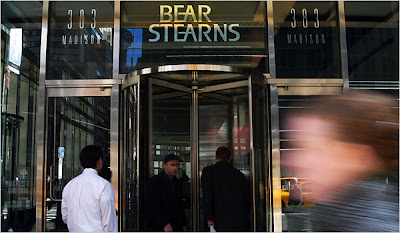
JP Morgan Goes On A Spree, Ends Up With Bear Stearns In It's Shopping Cart

JP Morgan Chase to buy Bear Stearns

While President Bush keeps trying to playdown America's economic woes and cable news is insisting that Reverend Jeremiah Wright will sink Barack's candidacy, JP Morgan Chase is making some interesting moves. The financial industry giant has decided to will acquire rival Bear Stearns for $2 a share in a move aimed at averting spreading panic in the financial markets over tightening credit.

JP Morgan says the all-stock deal has received the required approvals from the federal government and the Federal Reserve. The Fed will provide special financing to JPMorgan Chase in connection with the deal. The central bank has agreed to fund up to $30 billion of Bear Stearns' less liquid assets. For details of the deal, check out the NY Times.

Isn't is interesting how the federal government is not trying to "bail out" those most in need, while it's a whole different issue when fat cats screw up and need to "hooked up." Something tells me the big boys cut a deal on this under the guise of business just doing what business does. Man, I'm starting to feel like a serious conspiracy theorist.

Saturday, March 15, 2008

Stocks Plunge On Bear Stearns Bailout News: Is The Worse Yet to Come?

IS YOUR MONEY RAINING DOWN OR IS IT FLYING AWAY?

We don't want to paint a doom and gloom picture of the American economy. So look at the following story as information for all of us to diversify where our money is. (don't put it all in one place) We need to curb our spending and set up an emergency account in case something should happen and cash is the only thing that will be accepted to get us out of that jam. Here is what is going on with the "Big Boys" on Wall Street.

U.S. stocks plunged Friday after Bear Stearns Cos. had to be bailed out by the Federal Reserve, shocking Wall Street and ending a week that saw one of the best trading days in five years wiped out by the biggest scare yet in the ongoing credit crisis."

People realized that Bear Stearns just came out the other day saying everything was fine, said Paul Nolte, director of investments at Hinsdale Associates. "So, two days later, why would they need this funding from the Fed and J.P. Morgan? If it's like that for them, what is it like for Merrill Lynch or for Thornburg Mortgage?"

Where are we headed with one of the titans of Wall Street, Bear Stearns, needing a hand out? Kate Gibson at MarketWatch has got the rest of the outlook.

Saturday, March 8, 2008

FBI Probes Countrywide in Possible Fraud, Which Includes Exploiting Black Borrowers

As the whispers grow louder, Countrywide Financial Corp., the largest U.S. mortgage lender, is now officially under investigation by the Federal Bureau of Investigation for possible securities fraud.

Along with San Francisco-based Wells Fargo & Co., both were recently subpoenaed as part of an Illinois probe into whether minority borrowers were steered into higher-cost loans. Countrywide pledged to cooperate in any probe and said it analyzes its data to ensure that borrowers are treated fairly. Wells Fargo said race isn't a factor in lending.

Corporate CEO's get taken to the woodshed

Countrywide is among at least 14 companies that the FBI is checking for possible accounting violations related to the subprime lending crisis, including mortgage lenders, housing developers and Wall Street firms that package loans as securities. The FBI announced the review in January without identifying any of the companies.

Lenders are facing increased scrutiny from regulators as record foreclosures displace homeowners and depress property values. U.S. mortgage foreclosures rose to an all-time high at the end of 2007 as borrowers with adjustable-rate loans walked away from properties before their payments increased, the Mortgage Bankers Association said this week.

Countrywide yesterday declined 13 cents, or 2.5 percent, to $5.07 a share, 20 percent lower than its closing price on Jan. 11 when Bank of America, the nation's second-biggest bank by assets, offered to buy the company for about $4 billion in stock. The stock has declined 86 percent in the past year in New York Stock Exchange trading.

Forty-two percent of new foreclosures in the fourth quarter were people with adjustable-rate subprime mortgages, given to borrowers with limited or tainted credit records, according to the report. Those types of loans accounted for about 7 percent of all mortgages.

Investigators are focusing on whether Countrywide officials misrepresented the company's financial position and the quality of its mortgage loans in securities filings. [CNN]

Monday, February 11, 2008

With Business Hurting, Now Starbucks Is Willing To Give Free WiFi To Coffee Drinking Internet Addicts

Starbucks, which for years rejected giving away free Internet service at its stores, has reversed course and said Monday that it will begin offering limited, free Wi-Fi at more than 7,000 company-owned U.S. stores. You know Britney Spears is excited about this news, poor thing.

The switch to AT&T Inc. from T-Mobile will allow customers to receive up to two hours of free Internet service starting this spring. However, to access the Wi-Fi, customers must have a cash balance on an active Starbucks card, which is used to buy drinks, CDs or other items. Cards start at $5.

Seattle-based Starbucks Corp. said it has not worked out all the details as to how much of a cash balance must be on a card, and it has not set firm dates when the free Wi-Fi will begin. But its hometown likely will be among the first large cities to get the service as it is rolled out this year, said Chris Bruzzo, the company's chief technology officer. Full Starbucks Story